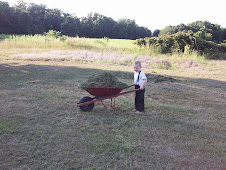
Great day of work today. Micah really contributed a lot while we worked on fixing a chicken tractor and finishing up the fencing around the new hen house. Farming is a great way to spend time with your children and enjoy an abundance of teaching and learning opportunities as well. The layers are really starting to grow, and we are moving them closer each day to the hen house so that they will be able to run cage free very soon. As one of our shareholders and fellow Quakers reminded me, when chickens get to eat naturally by picking through the grasses and other natural edibles, they produce eggs that are incredibly high in Omega 3. By September, we will have two grown layer flocks, and will have a lot of eggs for next season’s shareholders.
I said we were working on hen house fencing, and perhaps I should explain. We use portable tarp shelters for our layer hens, and they are easy for predators to get into by digging underneath the bottom edge of the tarp. To prevent this, we erect a welded wire fence around the outside of the shelter, and then lay chicken wire on the ground extending out from the welded wire. We zip-tie the chicken wire to the welded wire, then use tent stakes to keep the chicken wire tight to the ground. This has been effective in preventing raccoons from digging through into the hen house, unless you forget to shut the welded wire fence gate.
An interesting thing happened about a week and a half ago, and I didn’t write about it because I wasn’t sure what I was going to do. We lost a chicken from our layer flock, most likely because I didn’t feel like closing up the hen house (AS STATED ABOVE). Predators always return to the scene of their kill the very next night, so, as usual, I waited outside to hunt the predator. What I suspected would be a coyote (you can tell by the manner of the kill) turned out to be something entirely different. It was a huge fox! I was unable to raise my shotgun in time to shoot it cleanly, and so the fox went its own way. It did not return, but I got to thinking. It is one thing to kill a raccoon or a skunk, or a coyote. It is entirely another manner to shoot a beautiful animal like this fox that I saw in our pasture. Also, I think that many of our shareholders would feel the same way had they saw this animal. At any rate, the fox did not return, but I had to admit that this might pose a problem later in the season, and I can’t have predators circling the farm and helping themselves to chickens and who knows what else. So, I decided to make a significant investment in hopes of eliminating the need to kill predators.
I invested in a solar powered blinked LED light that guarantees to keep predators away from the area surrounding it. One light will not work, you need one every hundred feet or so, at least that is what is recommended. So we now own six of these lights at a cost of $34 each. This was a significant expense for our farm, but in the end, I hope that it eliminates any shareholder concerns about the need to eradicate predators. I also hope it will allow me to get to sleep at night during the summer, as raccoons and such don’t come out until 1 or 2AM.
Broilers come this Wednesday, and should be ready for pickup in eight weeks. We have a lot of fencing decisions to make before the sheep come, and we are going to feed out Jersey bull calves for beef for next year. We anticipated getting beef steers, but the prices for stock were nearly $600 more than we had budgeted for. We will need to save for breeding stock if we want to get any steers bred for beef. At any rate, the Jerseys are very pretty to look at, and they do well on grass, though they can be somewhat small, Hope to see you soon at Sandhill, bye for now.
Showing posts with label predators. Show all posts
Showing posts with label predators. Show all posts
Saturday, April 10, 2010

Wednesday, December 2, 2009
Sandhill's experiment with Broilers

OK, back to farming. One of the new enterprises that was undertaken at Sandhill was the addition of broilers to our ongoing farm experiment. We had raised layer hens for a few years, but we have never raised them for meat (except for culled roosters) until this past year. We decided to try two rounds of fifty broilers each. We followed the suggestions laid out by Andy Lee’s book entitle Chicken Tractor (There is more to the title, but I can’t recall it offhand) and commenced to building the pens that would hold the chickens.
The materials we purchased for the two 8’ by 10’ cages (three feet deep, two deep would have been better) cost us about $80 each, using 1” by 2” boards, chicken wire, and a rather expensive composite plastic corrugated covering. We fastened the sides and top, and the chicken wire with staples and three inch screws. We kept each panel separate in our basement where we erected them until the snow melted and we pieced each side together with zip ties and reinforced that with screws.
Next, it was time for the broiler chickens. We ordered the more marketable White Mountain crosses, which are bred to grow to five or six pounds (or more) in eight weeks. We are still not sure about ordering dual purpose heritage breeds for this year, which grow slower but are more in tune with our farming philosophy). At any rate, when you order fifty chicks of any breed, you have to brood them from one-day-old to the point where they are hearty enough to stand against the cold and other elements. Not having a brooder, and having eight barn cats in our garage, we made the decision to brood these first fifty chicks in our house because the May weather in Michigan last spring was still very cold, especially at night. First, I’d like to state that many people we have spoken with in our community have brooded chicks inside their homes. Secondly, I can tell you that each of us have reported that this is a most unpleasant experience. After brooding the chicks in a plastic swimming pool last season, this year we will build a brooder (To purchase one costs about $290 - $350)and place them in the garage with appropriate protection from the cats. You will never feel the need to clean as thoroughly as you will after having livestock in your house. (On the other hand, 10 or so layers, even 25 layers, are not as bad to brood in the house, as there is less waste to deal with).
Once they were hearty enough, we transferred the chicks out to the chicken tractors, and began to move them to fresh grass every day, and fed them broiler grower twice a day. We fed them a lot, but took seriously the instructions to keep them on feed for twelve hours, and then remove the feed for twelve hours, to reduce complications arising from over eating. We went through approximately 15 bags of feed in eight weeks costing around $13 a bag.
We faced two problems with our two sets of broilers. First, we lost nine chickens to the late July heat, not because they didn’t have enough water, but most likely because they didn’t have proper shade. One thing we know, the broilers will not walk more than three feet to drink water, so, if there is not proper shade, they will be overwhelmed by 90 degree heat. This was a tragedy around our farm, as we felt that if we would have been on the farm instead of working outside the home, we could have better protected the animals. An tarp solved this problem. The other problem was predators. We dealt with them severely, shooting two raccoons that had stolen two chickens from us, and one skunk that had killed two chicks. Predators always return to the scene of the crime, because they know it will be easy pickings. Raccoons, however, tend to come within four hours of darkness, and I only had to wait for a few hours before shooting them an hour apart with a twelve gauge. The skunk took some thought, however, as I was concerned about the release of musk. Skunks come in the morning, and I decided to use a .22 caliber rifle for the skunk. It worked, with minimal smell resulting. Many folks, especially Quakers, are concerned about the hunting of predators, as opposed to trapping them. In rural areas, once predators feel safe enough to approach human homes, they will continue to do so wherever they are released from live traps. To release a raccoon into another homes range is to give other home owners trouble. Also, when we tried a live trap in Ohio once, the raccoons were smart enough to steal the bait from the trap, then proceed to raid our barn for chickens. I am not about to live trap a skunk. As for pacifists having guns on the property, the reality of coyotes, small predators, injured game, and sick and dying animals is a reality of rural life, and hunting weapons, while not absolutely necessary, are a solution to such problems.
Back to chickens. Finally, after eight weeks of feeding broilers, it was time for butchering. There are many ways to prepare a chicken for butchering. I prefer to shoot them in the head while holding them upside down, as it is quick and painless. Killing cones will be added this year, because as the birds flap after death, the wings can break due to the force of the spasms. After they bleed out, I remove the head, then we scald them in 155-degree water that we have added dish soap to in order to ease the removal of feathers from the carcass. Picking a chicken by hand is a time consuming process, and for this year, we hope to build our own chicken picking machine ( A new chicken plucker from a manufacturer costs more than a thousand dollars). It will reduce the time to prepare a bird for butchering from 10 minutes per bird to 20 seconds for two birds. Once the bird is plucked, it is ready for dressing, which, after four or five birds, takes about three minutes or less. However, the first one might take as many as fifteen minutes. It simply takes practice. After dressing the bird, we clean out any remnants from dressing the bird in a water bath, then age the bird for a day or two in a refrigerator before freezing. Our shareholders can pick them up cold or frozen, either way. We have not received one complaint about our birds, and we love them ourselves. They taste great, even better when you raise them yourselves.
The materials we purchased for the two 8’ by 10’ cages (three feet deep, two deep would have been better) cost us about $80 each, using 1” by 2” boards, chicken wire, and a rather expensive composite plastic corrugated covering. We fastened the sides and top, and the chicken wire with staples and three inch screws. We kept each panel separate in our basement where we erected them until the snow melted and we pieced each side together with zip ties and reinforced that with screws.
Next, it was time for the broiler chickens. We ordered the more marketable White Mountain crosses, which are bred to grow to five or six pounds (or more) in eight weeks. We are still not sure about ordering dual purpose heritage breeds for this year, which grow slower but are more in tune with our farming philosophy). At any rate, when you order fifty chicks of any breed, you have to brood them from one-day-old to the point where they are hearty enough to stand against the cold and other elements. Not having a brooder, and having eight barn cats in our garage, we made the decision to brood these first fifty chicks in our house because the May weather in Michigan last spring was still very cold, especially at night. First, I’d like to state that many people we have spoken with in our community have brooded chicks inside their homes. Secondly, I can tell you that each of us have reported that this is a most unpleasant experience. After brooding the chicks in a plastic swimming pool last season, this year we will build a brooder (To purchase one costs about $290 - $350)and place them in the garage with appropriate protection from the cats. You will never feel the need to clean as thoroughly as you will after having livestock in your house. (On the other hand, 10 or so layers, even 25 layers, are not as bad to brood in the house, as there is less waste to deal with).
Once they were hearty enough, we transferred the chicks out to the chicken tractors, and began to move them to fresh grass every day, and fed them broiler grower twice a day. We fed them a lot, but took seriously the instructions to keep them on feed for twelve hours, and then remove the feed for twelve hours, to reduce complications arising from over eating. We went through approximately 15 bags of feed in eight weeks costing around $13 a bag.
We faced two problems with our two sets of broilers. First, we lost nine chickens to the late July heat, not because they didn’t have enough water, but most likely because they didn’t have proper shade. One thing we know, the broilers will not walk more than three feet to drink water, so, if there is not proper shade, they will be overwhelmed by 90 degree heat. This was a tragedy around our farm, as we felt that if we would have been on the farm instead of working outside the home, we could have better protected the animals. An tarp solved this problem. The other problem was predators. We dealt with them severely, shooting two raccoons that had stolen two chickens from us, and one skunk that had killed two chicks. Predators always return to the scene of the crime, because they know it will be easy pickings. Raccoons, however, tend to come within four hours of darkness, and I only had to wait for a few hours before shooting them an hour apart with a twelve gauge. The skunk took some thought, however, as I was concerned about the release of musk. Skunks come in the morning, and I decided to use a .22 caliber rifle for the skunk. It worked, with minimal smell resulting. Many folks, especially Quakers, are concerned about the hunting of predators, as opposed to trapping them. In rural areas, once predators feel safe enough to approach human homes, they will continue to do so wherever they are released from live traps. To release a raccoon into another homes range is to give other home owners trouble. Also, when we tried a live trap in Ohio once, the raccoons were smart enough to steal the bait from the trap, then proceed to raid our barn for chickens. I am not about to live trap a skunk. As for pacifists having guns on the property, the reality of coyotes, small predators, injured game, and sick and dying animals is a reality of rural life, and hunting weapons, while not absolutely necessary, are a solution to such problems.
Back to chickens. Finally, after eight weeks of feeding broilers, it was time for butchering. There are many ways to prepare a chicken for butchering. I prefer to shoot them in the head while holding them upside down, as it is quick and painless. Killing cones will be added this year, because as the birds flap after death, the wings can break due to the force of the spasms. After they bleed out, I remove the head, then we scald them in 155-degree water that we have added dish soap to in order to ease the removal of feathers from the carcass. Picking a chicken by hand is a time consuming process, and for this year, we hope to build our own chicken picking machine ( A new chicken plucker from a manufacturer costs more than a thousand dollars). It will reduce the time to prepare a bird for butchering from 10 minutes per bird to 20 seconds for two birds. Once the bird is plucked, it is ready for dressing, which, after four or five birds, takes about three minutes or less. However, the first one might take as many as fifteen minutes. It simply takes practice. After dressing the bird, we clean out any remnants from dressing the bird in a water bath, then age the bird for a day or two in a refrigerator before freezing. Our shareholders can pick them up cold or frozen, either way. We have not received one complaint about our birds, and we love them ourselves. They taste great, even better when you raise them yourselves.
Subscribe to:
Comments (Atom)